Risk Update

Risk News — Update on BRB Salary Survey, Television Risk Revealed, Carrot Top Accuser Calls Conflict, Firm Rejects Disqualification as Based on “Manufactured” Conflicts

Posted on

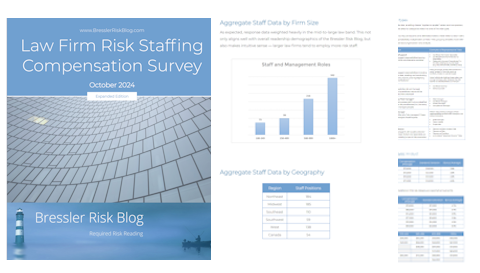
Quick Update on the BRB Risk Compensation Survey:

I’m quite pleased to see continued strong interest in our annual salary survey! I wanted to drop a quick note with a clarification/recommendation, based on a note from one firm.

Short version: Yes, you can totally have HR reach out directly to engage with this survey and submit data on behalf of the firm.

This comes up a few times each year. It’s not unusual for someone in risk to pass the survey on to HR. It’s fine to have an HR analyst fill things out. Just have them note their own title/email in the exercise, which will used solely to provide them with the final report.

Alternatively, from time to time a firm reaches out wanting to provide data via Excel vs the survey form. I’m happy to work with organizations to accommodate, so long as we’re able to collect the specific comp characteristics we’re looking for. Just sent those folks my email address (responses to the daily update go back directly to me) or the contact form on the blog to get in touch.

Thanks. And now back to your regular updates.


Talking to clients, or potential clients, or about work in law firm conference rooms containing an LG televisions? It may be prudent to investigate the implications of this news: “LG TVs caught spying even when offline or on standby” —

  • “Smart TVs are built to siphon your data and sell it to advertisers or whomever else wants to know your viewing habits. LG, a screenmaker already coming off of a monitor adware scandal, has reportedly given its screens the ability to capture audio from your living room, even if the TV seems like it’s turned off.”
  • “LG’s TVs can be sending this data even if the screen is off, according to the YouTubers’ findings. Gizmodo reached out to LG for comment, and we’ll update this post if we hear back. LG’s privacy policy explicitly gives the company consent to send data to advertising partners or law enforcement. LG also says it ‘may collect audio, electronic, visual, or similar information, such as video recordings’ through its ThinkQ app.”
  • “The amount of data LG’s screens can log is staggering. The video describes how, with a few changes, these TVs are apparently able to identify devices using the home network, even those that aren’t actually connected to the TV itself. That includes the ability to identify several smartwatches and phones all on the same network.”
  • “Security researchers who analyzed Gamer’s Nexus findings suggested that users disconnect their LG TVs from the internet. That’s not necessarily out of privacy considerations but more so for all the potential vulnerabilities hackers could potentially exploit.”
  • “The bigger problem isn’t necessarily how some ne’er-do-well could hack your home screen to spy on you while it’s off; it’s the fact your data isn’t just used by advertisers. U.S. law enforcement has been caught buying advertising data from data brokers as yet another form of surveillance.”
    “That data can be linked directly to individuals, where such voice transcripts would be invaluable information for any law enforcement or government agency keeping tabs on U.S. residents. LG’s data collection may be especially egregious. Still, every TV owner is essentially giving up their privacy for the sake of buying a cheaper screen.”

Do take note that if your firm does use LG TVs, you may have a duty to inform everyone in the room (and maybe even on the network) where this happens. (Will let you ask your lawyers to navigate the implications. No legal advice here.) From LG’s Terms:

  • “CONSENT REQUIREMENT: You acknowledge and agree that it is your sole responsibility to obtain all necessary consents from any third parties whose voices may be captured by the Product and to notify household members and guests that their voices may be captured and processed, in compliance with applicable wiretapping, eavesdropping, and privacy laws. If anyone does not consent, you should disable the microphone or voice features in the settings. LGE disclaims any liability for your failure to obtain such consent or provide such notification.”


Carrot Top Accuser Wants Comic’s Lawyer Banned From Explicit Video Lawsuit – Claims Conflict of Interest” —

  • “Billboard chart singer Brian Evans is demanding that Carrot Top’s lawyer be banned from their explosive legal battle, claiming the comedian’s attorney is caught in a conflict of interest that threatens the integrity of the case, RadarOnline.com can reveal. Evans has filed a motion seeking to disqualify attorney Ronnie J. Bitman and his firm, Bitman O’Brien, PLLC, from representing the comic, whose real name is Scott Thompson.”
  • “According to court documents obtained by Radar, Evans claims Bitman is simultaneously representing Chad Fitzgerald, a defendant in a separate lawsuit Evans filed against Fitzgerald and his law firm, in a pending federal appeal – while also defending Carrot Top in the bombshell case.”
  • “Evans argues the overlapping representation creates a major problem since Carrot Top’s defense could eventually require his attorney to investigate Fitzgerald’s conduct or take positions that could potentially hurt Fitzgerald’s interests. The filing claims Carrot Top may need to obtain documents from Fitzgerald, subpoena or depose him, challenge his account, or attempt to place responsibility on Fitzgerald or another person for the later handling of disputed settlement documents.”
  • “Evans argues Bitman cannot independently advise Carrot Top about taking those steps while simultaneously owing Fitzgerald duties of loyalty and confidentiality.”
  • “Evans wants Bitman and his entire firm immediately prohibited from filing motions, conducting discovery, attending hearings, participating in depositions, or otherwise acting as Carrot Top’s counsel while the judge determines whether they should be disqualified.”
  • “The latest courtroom clash comes amid Evans’ disturbing allegations about his former personal and professional relationship with the Las Vegas entertainer.”
  • “Evans is now asking the judge to disqualify Bitman and his firm or schedule an expedited evidentiary hearing to determine whether the alleged conflict prevents them from continuing to represent Carrot Top.”

Fish & Richardson Slams IP DQ Bid As Possibly Manufactured” —

  • “LVMH urged a Texas federal court to reject a bid to boot Fish & Richardson PC from defending the luxury goods business against an infringement lawsuit over patents for nonfungible token display technology, saying the company behind the suit may have tried to ‘manufacture’ a conflict to disqualify the firm.”
  • “LVMH Moët Hennessy Louis Vuitton SE argued Monday that Watch Skins’ disqualification motion should be rejected based on its own misconduct, which included oversharing information with the firm and cold-calling a firm attorney.”
  • “‘The record demonstrates, at every turn, that Watch Skins — not Fish & Richardson PC — is the party that acted improperly,’ LVMH said. ‘Watch Skins ignored multiple warnings not to share confidential information, ignored Fish’s decision to decline representation, and then, through a sophisticated co-founder represented by an experienced IP litigator, unilaterally transmitted information no one at Fish had requested.'”
  • “Watch Skins alleges Paris-based LVMH and three other companies under the LVMH umbrella, including Swiss watchmaker TAG Heuer SA, infringed three of its patents on NFT smartwatch display technology. Watch Skins developed a platform that enables users to display their NFTs.”
  • “LVMH said that while it could be that Watch Skins meant to ‘manufacture a conflict,’ its intent does not matter, because the firm carefully followed the rule regarding a lawyer’s duty to a prospective client. LVMH said the American Bar Association’s ‘safe harbor of Rule 1.18(d), now adopted in Texas, exists precisely to address this situation.'”
  • “LVMH said it was contacted twice by Watch Skins, once via its website in December 2023 and a second time in July 2024 through a cold call to Fish & Richardson attorney Jennifer Huang, who is not listed as counsel in the instant case. LVMH said Watch Skins’ motion to disqualify the firm ‘misleads the court’ by not mentioning the website inquiry.”
  • “Fish & Richardson’s website warns prospective clients against providing any confidential or sensitive information, but Watch Skins did it anyway, LVMH said. After receiving the website form from Watch Skins, the firm declined representation because it had a history of representing LVMH and warned Watch Skins again not to ‘share confidences.'”
  • “‘This attorney also took steps to limit exposure to confidential information: requesting only specific categories of information necessary to screen a potential contingency representation and waiting for conflict clearance before disseminating any information received,’ LVMH said. Despite already being represented by other counsel and in disregard of Huang’s ‘limiting instructions,’ Watch Skins again ‘overshared,’ LVMH said. ‘The attorney promptly removed the additional information from her inbox and declined representation,’ LVMH said, adding that Huang has been screened from the matter.”
  • “‘No prospective client should be allowed to poison a client’s law firm by arguing a conflict should be imputed under these circumstances,’ LVMH said, later adding that ‘Watch Skins has no explanation for waiting 15 months into active litigation before taking the drastic step of seeking Fish’s disqualification; it has waived the request.'”
  • “LVMH said ‘this is a textbook case’ for the safe harbor exception spelled out in the ABA and Texas rules.”
jobs

BRB Risk Jobs Board — OGC Counsel – Conflicts & Ethics (Latham)

Posted on

In this latest jobs update, I’m pleased to spotlight an open role at Latham & Watkins: “OGC Counsel – Conflicts & Ethics” —

  • The OGC Counsel is an integral part of Latham’s Office of the General Counsel team.
  • This role will be responsible for resolving professional ethics conflicts and related compliance issues by applying legal ethics rules, professional responsibility principles, Latham & Watkins policies, and practical judgment to lateral clearances, new business matters, outside counsel guidelines, engagement terms, waivers, ethics walls, and related risk-management issues, while coordinating with partners, Ethics Committee Members, and other stakeholders to resolve conflicts issues, communicating status updates and following through until the matter is resolved or appropriately escalated.
  • This role can be located in any of our US offices.
  • Please note that this role may be eligible for a flexible working schedule that allows for a hybrid and in-office presence.


Responsibilities & Qualifications

  • Conflicts of Interest
    • Applying knowledge of professional responsibility rules and relevant Latham procedures, policies, and practices to resolve lateral attorney and new matter conflicts, advising Ethics Committee Members, firm attorneys, and other stakeholders throughout the process
    • Reviewing situation-specific conflicts checks as needed; analyzing the results in light of applicable rules and firm policies; identifying potential conflicts of interest and determining appropriate next steps, including clearance, waiver, screening, or escalation
  • Engagement Terms & Other Issues
    • Analyzing outside counsel guidelines, non-standard engagement letters, and RFPs received from clients; identifying issues related to conflicts, ethics, liability, and firm policy; coordinating with partners and other stakeholders to resolve or escalate those issues
    • Drafting, reviewing, and advising on waivers, ethics walls, engagement letters, and related documents in coordination with Senior Counsel and Managing Counsel as appropriate
  • Legal Research & Training
    • Conducting legal research on ethics rules, professional responsibility issues, and conflicts-related topics as needed to support the resolution of assigned matters or team projects
    • Helping prepare and deliver trainings for attorneys and staff on conflicts, ethics, professional responsibility, and related topics, in collaboration with Senior Counsel, Managing Counsel, and other OGC colleagues
  • General & Administrative
    • Contributing reliably to shared inboxes, urgent matters, weekend coverage, and team processes
    • Supporting partner audits and other OGC or Ethics Committee projects in collaboration with Senior Counsel, Managing Counsel, and other OGC colleagues
    • Protecting and maintaining any highly sensitive, confidential, privileged, financial, and/or proprietary information that Latham & Watkins retains


We’d love to hear from you if you:

  • Demonstrate knowledge of legal ethics rules, professional responsibility principles, and conflicts of interest analysis
  • Display strong written and oral communication skills, with excellent attention to detail and the ability to translate conflicts and ethics concepts into practical guidance
  • Possess the ability to communicate effectively and professionally with attorneys, OGC colleagues, Ethics Committee Members, Analysts, Assistants, and business professionals at all levels of the firm


And have:

  • A Juris Doctor (JD) or equivalent
  • Admission to the relevant state bar with active status
  • Minimum of two (2) years of experience in legal ethics, conflicts of interest, professional responsibility, or a closely related area of law firm risk management required; law firm experience preferred.
  • Experience with conflicts clearance processes, engagement terms, outside counsel guidelines, waivers, or ethics walls is strongly preferred.


About Latham & Watkins

  • Latham & Watkins is one of the world’s leading global law firms advising the businesses and institutions that drive the global economy.
  • We are the market leaders in major financial and business centers around the world. Our investment in people, commitment to innovation, and focus on the future empower you to build an incredible career and thrive as an exceptional professional in a supportive culture.
  • If you aspire to be the best, and work with the best, this is where you belong.


See their careers page for more on the firm and work environment, see the complete job posting for more details on the position and to apply.


And if you’re interested in seeing your firm’s listings here, please feel free to reach out

Risk Update

Conflicts & Ethics News — Representations Stunt Spurs Conflict Clash, Standing in Seattle on Disqualification Motions, County Auditor Exits Attorneys

Posted on

Longtime reader Roy Simon, the Howard Lichtenstein Distinguished Professor Emeritus of Legal Ethics at Hofstra University, sent word that he’s looking for a lawyer who is in good standing in New York interested in being a co-author for the next edition of: “Simon’s New York Rules of Professional Conduct Annotated.” He writes:

  • “If you could put out a general call for interest, that would be very helpful.  The treatise is in its 24th edition (with the 25th at the publisher) and is now over 2000 pages. It requires a good deal of upkeep — New York’s Courts amended 20 separate provisions in the New York Rules of Professional Conduct in 2025, and a few more rules are likely to be amended this year or early next, plus I summarize every new ethics opinion from a New York ethics committee (about 20 total opinions a year), plus major court decisions.  But I enjoy every minute working on the book and I think a co-author would as well.  I would of course share royalties in a fair way with any co-author(s).”
  • If interested, you can find his contact information: here.

David Kluft spotsthe best stuff. His latest: “Can I create a conflict of interest by falsely declaring I represent my opponent?” —

  • “The majority owner of a CA car dealership fired the manager, who was also a minority owner. When the manager kept coming to work and refused to leave, the dealership initiated a trespass action against him. The manager hired a lawyer to represent him in the trespass proceedings.”
  • “Meanwhile, the dealership was also in hot water with the manufacturer, which issued a notification that it was terminating the franchise. The majority owner filed a separate suit on behalf of the dealership to protest this.”
  • “The manager decided to interfere with the franchise action by engaging in a stunt. He had his lawyer from the trespass case intervene in the franchise case and also a file a protest, purportedly on behalf of the dealership (i.e., ‘I’m the real owner of this franchise!’).”
  • “The manager and his lawyer were bounced from the franchise case for lack of standing. This caused the dealership to move for the manager’s lawyer’s disqualification from the trespass case. The argument basically was: if he says (even incorrectly) that he represents the dealership in the franchise case, he can’t be adverse to the dealership in this case.”
  • “The manager’s lawyer’s defense was essentially that he never really represented the dealership – he just said he did to make a rhetorical point on behalf of his client. The manager’s lawyer cited case law in which an attorney representing a corporate defendant in a class action lawsuit incorrectly informed the court that he represented the employees too, and the Court of Appeal held that this incorrect unilateral declaration cannot create an attorney client relationship and therefore it cannot create a conflict.”
  • “However, here, the record contained evidence that this was not merely a mistake: a client (the manager) with apparent authority (because he was also a minority owner) hired a lawyer expressly to represent the dealership, and the lawyer represented himself as such many times, notwithstanding the whole thing being a dumb stunt. The lawyer was disqualified.”
  • Decision: here.

Federal Court in Seattle Addresses Standing for Disqualification Motions” —

  • “The Rules of Professional Conduct (RPC) typically supply the substantive law of disqualification for determining, for example, whether a law firm has a conflict. The procedural elements of disqualification, by contrast, are court-made law. A recent case from the federal district court in Seattle illustrated a key procedural aspect of disqualification litigation: standing. “
  • “As a general proposition, the party bringing a disqualification motion must be either a current or former client of the targeted law firm and the burden is on the moving party to demonstrate that requisite standing. ”
    “Shenzhen Yihong Technology Co. Ltd. v. Dbest Products, Inc., 2026 WL 2267436 (W.D. Wash. Aug. 6, 2026) (unpublished), is a patent-infringement case. Plaintiff’s counsel had handled earlier cases against the same defendant. During those earlier cases, the defendant’s lawyers had provided discovery to plaintiff’s counsel and negotiated settlements. Plaintiff’s counsel, however, had never represented the defendant. Nonetheless, the defendant moved to disqualify plaintiff’s counsel—arguing that the knowledge it had gained through its prior work was disqualifying. The court denied the motion. “
  • “The court began by finding that the defendant lacked standing to bring the motion because it had never been a client of plaintiff’s counsel. The court then went on to conclude that simply obtaining information about an opponent through either discovery or settlement negotiations did not provide an alternative basis for standing. While the decision doesn’t plow any new analytical ground, it includes a useful survey of the law on standing in disqualification. The decision also serves as a reminder of the important role court-made procedural law plays in disqualification litigation.”

Judge: Madison County auditor must find new attorney, county will pay” —

  • “Madison County Auditor Michele Brant will have to find a new attorney to represent her in her case against two county supervisors.”
  • “On Friday, a judge disqualified County Attorney Stephen Swanson from representing Auditor Brant in the case due to a conflict of interest. However, the judge rejected the idea that Brant should have to pay for her own attorney.”
    In the overarching case, Brant claims that supervisors Jessica Hobbs and Heather Stancil retaliated against her after she filed a civil rights complaint. Hobbs and Stancil later voted to restructure Brant’s office and repeatedly denied her efforts to hire for a position within her office, even though it had already been approved within the budget.”
    Swanson, who would normally represent the board in his position as county attorney, had argued during a July hearing that there was no conflict of interest since Stancil and Hobbs voted months ago to retain a high-end legal firm to represent them in county matters.”
  • “The judge disagreed, finding that Swanson is required by statute to represent Madison County and its officers, according to court records.”
  • “Under Iowa Code §331.759, the court ordered that the reasonable and necessary costs of representing Brant in her official capacity as Madison County Auditor be paid from Madison County’s general fund. Stancil and Hobbs, and their $305-per-hour taxpayer-funded attorney, had tried to argue that Brant should pay for the legal fees herself since the board approves litigation fees and it would be unlikely that Stancil and Hobbs, who together make up a board majority, would vote in favor of the move.”
  • “The ruling does not resolve the underlying retaliation case. For now, there is a court-ordered pause on the effort to make any changes to Auditor Brant’s office.”
  • Decision: here.
jobs

BRB Risk Jobs Board — Matter Mobility Manager (Bass Berry)

Posted on

Pleased to spotlight a new risk opening at Bass, Berry & Sims: “Matter Mobility Manager” —

Summary:

  • The Matter Mobility Manager will have responsibility for the intake, transfer, and release of client files and matter-related information as attorneys and clients join or depart the firm.
  • Reporting to the Chief Risk Management Officer, this position serves as the firm’s primary point of contact for lateral attorney file transfers, working directly with incoming and departing attorneys, their staff, prior firms, and clients to ensure that matter mobility is handled with accuracy, professionalism, and appropriate attention to the firm’s legal and ethical obligations.
  • This is a hands-on role for a practitioner who combines process discipline with strong interpersonal skills. The successful candidate will personally manage matter mobility work while designing the workflows, documentation, and standards that will allow the function to scale with the firm’s continued growth.

Responsibilities:

  • Serve as the firm’s primary point of contact for lateral attorney integration as it relates to client file transfers, coordinating with incoming attorneys, prior firms, clients, and internal departments including Conflicts, Information Technology, and Research & Information Governance.
  • Manage the end-to-end matter mobility process for incoming and outgoing attorneys and clients, including intake of electronic and physical client files, verification of file completeness, and appropriate documentation of transfers.
  • Communicate directly with attorneys and firm leadership regarding transfer status, timelines, and expectations, providing a high level of client service throughout the integration process.
  • Develop, document, and continuously improve standardized workflows for matter intake, transfer, and release consistent with applicable ethical and legal requirements.
  • Coordinate with the Research & Information Governance Manager to ensure transferred matter information is appropriately incorporated into the firm’s document management and records systems.
  • Advise attorneys and staff on matter mobility procedures and obligations, including file release requirements upon client or attorney departure.
  • Support the firm’s broader risk management objectives, including the development of documentation practices that support future audit readiness.
  • Undertake other duties as requested by the Chief Risk Management Officer.


Requirements. To perform this job successfully, an individual must:

  • Bachelor’s degree or equivalent experience required.
  • Minimum of five years of experience in records management, information governance, matter mobility, or a related function within a law firm or professional services environment.
  • Direct experience managing lateral attorney file transfers or comparable matter lifecycle processes strongly preferred.
  • Proficiency with iManage or comparable document management systems; familiarity with Intapp or similar intake and conflicts platforms desired.
  • Familiarity with secure file transfer platforms and data migration tools used in law firm matter transfers; experience with transfer-related workflows in iManage (such as imports, exports, and matter-level security) preferred.
  • Working knowledge of the ethical and legal requirements governing client file ownership, transfer, and release.
  • Exceptional interpersonal and client service skills, including the professional presence to work directly with attorneys, firm leadership, and external counsel, and the judgment to manage expectations under time pressure.
  • Strong organizational skills and meticulous attention to detail.
  • Demonstrated ability to build processes and documentation from limited existing structure.
  • Team orientation and the ability to partner effectively across administrative departments.


About Bass Berry & Sims

  • At Bass, Berry & Sims, the contributions of every employee are highly valued as part of the firm’s success. Whether you are involved behind the scenes or have direct contact with clients, you will be part of an exceptional team committed to providing superior service to our attorneys, our clients and the communities in which we live.
  • We believe our strength lies in the diversity of perspectives, experiences, and talents that each individual brings to our firm. We are committed to fostering an inclusive culture where every person is valued, supported, and empowered to contribute meaningfully. By embracing and celebrating our differences, we create an environment where innovation thrives, and exceptional client service is delivered.
  • Bass, Berry & Sims is committed to the well-being of everyone who works at the firm. In demonstration of this commitment, we were one of the first law firms to sign on to the American Bar Association’s (ABA) Well-Being Pledge. The Pledge aims to improve the mental health landscape and to prevent substance use within the legal profession.


See their careers site for more on the firm and work environment, see the complete job posting for more details on the position and to apply.


And if you’re interested in seeing your firm’s listings here, please feel free to reach out

Risk Update

AI OCGs, You See — OCGs and Client Needs for Firm AI, Guidelines, Guardrails and AI Growth

Posted on

These sentiments definitely align with the feedback shared by risk leaders in the survey report on AI for law firm risk we published last week.

What Corporate Clients Want to Know About Law Firms’ Use of AI” —

  • “Artificial intelligence has become a routine topic of discussion between law firms and their corporate clients, but the nature of those conversations has changed significantly over the past few years. Early discussions often centered on whether outside counsel should use AI at all. Today, clients have moved beyond that threshold question and instead want to understand how AI is being used, what safeguards govern its use, and how it can create greater value without compromising quality, confidentiality, or professional judgment.”
  • “Rather than asking whether a firm uses artificial intelligence, clients want to understand how AI fits into legal workflows, which tools are being used, what tasks they support, how client information is protected, and what level of attorney oversight exists before work product reaches the client.”
  • “As Andrew Woolf, Chief Strategy and Innovation Officer at Cozen O’Connor, explained: ‘Across the board, the questions are becoming more practical, detailed, and technical. The question has moved from ‘Are you using AI?’ to ‘How are you using it, and how are you controlling it?’’ He explained that clients want detailed information regarding the AI models and platforms firms use, whether client data is retained or used for model training, what security controls are in place, and how attorneys supervise AI-assisted work.”
  • “Several interviewees also observed a notable shift in client attitudes toward AI itself. Aubrey Bishai, Chief Innovation Officer at Vinson & Elkins, explained that conversations have evolved from clients saying, ‘Don’t use AI on my matters’ to now saying, ‘Please use AI on my matters where it makes sense.’ According to Bishai, today’s discussions focus less on whether AI should be used and more on where it can appropriately support legal work, while fostering greater transparency and collaboration between law firms and in-house legal departments.”
  • “Alma Asay, Chief Innovation and Value Officer at Crowell & Moring, similarly noted that clients are increasingly addressing AI through outside counsel guidelines, requests for proposal (RFPs), and governance surveys. Rather than imposing blanket prohibitions, many clients now permit AI use within defined parameters while requesting consultation before AI is used in higher-risk situations. She also observed that clients frequently ask what peer organizations are doing, reflecting an industry-wide effort to benchmark AI governance practices.”
  • “As Ashton Batchelor, Chief Innovation and Value Officer at Blank Rome, explained: ‘Innovation and AI governance aren’t mutually exclusive; they reinforce each other.’ Rather than trading confidentiality or quality for efficiency, clients increasingly expect firms to leverage AI responsibly while maintaining the same standards of legal excellence they have always demanded.”
  • “Bishai echoed that sentiment, explaining that clients are simultaneously focused on innovation, efficiency, confidentiality, security, and quality. She emphasized that enterprise-grade AI platforms, attorney training, and alignment among people, processes, and technology have become essential components of responsible AI adoption. Firms are also collaborating with clients by sharing lessons learned and helping develop best practices as both sides continue to integrate AI into legal work.”
    Attorney accountability emerged as another recurring theme. Asay noted that, regardless of technological advances, ‘Ultimately what they are paying for is our lawyers’ legal advice and judgment’ and that clients continue to expect attorneys to understand both the benefits and limitations of AI, independently verify AI-generated work, and remain personally responsible for the final legal product.”
  • “AI Governance Is Becoming Part of Outside Counsel Selection. As Asay put it, ‘It’s not looking ahead, it’s today.’ She explained that clients are already incorporating AI considerations into panel counsel selection, RFPs, outside counsel guidelines, and governance reviews. RFPs now often require firms to explain how AI will be used on specific matters, while clients are seeking greater transparency regarding governance policies, attorney supervision, approved technologies, and documentation surrounding AI use.”
  • “The industry leaders we spoke with also identified several emerging governance trends, including formal written AI governance frameworks, explicit supervisory responsibilities for attorneys overseeing AI-assisted work, documentation regarding when and how AI is used, and growing interest in standardized governance models that can be applied consistently across outside counsel relationships.”
  • “Batchelor compared AI governance to the evolution of cybersecurity requirements, observing that ‘AI governance is becoming as ubiquitous as information security and pricing in outside counsel engagements.’ While governance expectations continue to evolve, she expects greater convergence across the legal industry as clients and firms develop more consistent standards for responsible AI use.”

Rethinking Outside Counsel Guidelines for the AI Era: Ohio’s AI Ethics Guidelines as a Template for Legal Teams” —

  • “AI Is Now Embedded in Client Expectations. One of the most important developments goes beyond formal guidance. Clients now ask direct questions about AI use.They want to know whether their counsel uses AI, how it is governed, and what safeguards are in place to protect their data.”
  • “This demand has already reshaped outside counsel guidelines (OCGs). What began as simple disclosure language now includes detailed governance requirements, approved tool lists, and data retention expectations.”
  • “Prepare for client scrutiny be developing a clear AI usage policy. Align it with client expectations and industry norms, and be ready to explain how your approach improves efficiency and controls risk.”
  • “Firms that answer these questions confidently gain a competitive edge.”
  • “Governance Must Move Beyond Quick Fixes. AI governance is no longer a one-line policy update. It requires integration across the business.”
  • “Retention policies, discovery readiness, supplier management, and internal training all come into play. Even AI search histories may become discoverable in certain contexts, making documentation and retention decisions critical.”
  • “Teams must build a structured governance model:”
    • “Define retention rules for AI interactions”
    • “Align policies with discovery obligations.”
    • “Regularly review and update guidance as tools evolve.”
  • “Quick fixes will not hold up under scrutiny. Comprehensive governance will.”
  • “Ohio’s guidance does not break new ground. That is precisely its value. It confirms that responsible AI use in legal practice rests on familiar principles. Competence, confidentiality, supervision, and fair billing remain the foundation. The difference lies in how those principles apply when AI is involved.”
  • “Legal teams are empowered to use AI to improve efficiency and reduce cost. To do so, maintain rigorous oversight and ethical discipline and align practices with client expectations and evolving standards.”
  • “This approach strengthens defensibility, builds client trust, and creates a more consistent, scalable model for adopting AI with confidence.”

From permission to performance: What clients now expect from AI-enabled law firms” —

  • “We recently had the chance to talk with Chief Information Officer Skip Lohmeyer and Partner and Public Finance Attorney Carlos Manzano from Parker Poe about the rapidly evolving conversation about AI between in-house teams and outside counsel, and what that means for how firms operate and how clients select the right teams to hire.”
  • “Carlos Manzano: Two or three years ago, clients were mostly asking whether AI use was permissible… In 2026, that conversation has fundamentally shifted. Today, in-house legal teams are leveraging AI themselves to compress timelines, reduce routine work, and handle high volumes. Clients are benchmarking firms against their own operations and asking not whether their law firm uses AI, but what value outside counsel can actually deliver that their own capable teams cannot. The expectation has moved from permission to performance, and the firms that have not kept pace are starting to feel it.”
  • “What makes this shift particularly meaningful is the gap it has started to expose. The capabilities of generative AI tools have raised the floor for everyone providing legal services. The tools that felt like differentiators eighteen months ago are rapidly becoming baseline expectations. The more important competitive shift, though, is how AI empowers lawyers to raise the ceiling.”
  • “Skip Lohmeyer: Increasingly, clients view AI through the lens of risk management, operational efficiency, and business value. We see that reflected in conversations with clients, in RFPs, and in outside counsel guidelines.”
  • “Many clients are establishing expectations around confidentiality, data security, transparency, and attorney accountability when AI is used. At the same time, a growing number are asking different questions: where is AI improving efficiency and responsiveness, why would a law firm not use it responsibly, and how is it reducing legal costs?”
  • “What has not changed is accountability. Clients hire lawyers for judgment, experience, and trusted counsel. AI can help us work more efficiently, but it does not replace legal analysis or professional responsibility. We remain accountable for every work product we deliver and every recommendation we make.”
    “Skip Lohmeyer: We evaluate AI through three lenses: client value, risk management, and practical implementation. If a tool can help us deliver work more efficiently, provide deeper insight, or improve responsiveness while maintaining appropriate safeguards, we explore how to incorporate it into our workflows.”
  • “At the same time, we recognize that clients have different expectations and risk tolerances. Some clients are encouraging broader AI adoption. Others prefer tighter controls. We have built our governance and operational processes to support both.”
    “Carlos: Make governance a non-negotiable part of the evaluation as well. In-house counsel should understand whether the firm’s approved tools can train on client data, what security or privacy commitments apply, and who is ultimately accountable for AI-assisted work product before it reaches the client.”
Risk Update

BRB Law Firm Risk Staffing Compensation Survey (2026 Edition) — Now Open!

Posted on

Hot off the heels of the recent release of the agentic AI for law firm risk survey report, I’m pleased to invite our law firm risk readers to participate in the 2026 Risk Staffing Compensation Survey [HERE]

Last year’s exercise, our fourth go, was a great success. We saw participation from 108 individuals, providing nearly 700 data points on US-based risk positions.

Given the large number of report requests over the past year, I once again think we still have room to grow in 2026 numbers! (For those who don’t participate, the fee for a report/personal benchmark will go up in 2027. So, there’s an incentive to contribute.)

Given feedback on the last report, I think we’ve arrived at good framework for collecting both quantitative and qualitative data. We’ve edited a question or two, but folks should find the exercise familiar.

It’s gratifying to see mangers using this data to pursue adjustments for their team and to support recruiting processes. I’m also always happy to hear from individuals using this industry data to self advocate.

So if you’re an individual contribution looking to understand how your comp compares to your peers, or you’re a risk director/manager looking to keep your team (and potential new hires) on par with changing market standards, you don’t want to miss out.


SURVEY DETAILS:

  • Participation open to law firm risk professionals only
  • All responses will be treated confidentially
  • Risk Director / Manager participants sharing data on themselves and their team’s roles and compensation will receive a report summarizing key findings and analysis relevant to their firm demographics
    • (The report may be shared internally within your firm, but not redistributed externally. So if you want the results, your best path is to participate!)
    • NOTE: You’ll need to provide detail on the number of risk staff at your firm and compensation details on yourself and all reports, or you risk a survey report “disqualification.”
    • And if you want the Q&A results section, you’ll need to participate in that optional section as well.
  • Individual contributor participants sharing personal compensation data will be receive a personal benchmark compensation summary relevant to their specific role and firm demographics.

The survey will be open through September 30, and can be accessed here: 2026 Risk Staffing Compensation Survey.

Feel free to share the link with law firm peers and colleagues!

And if anyone has questions (or really needs more time), please do reach out to me directly. (Email readers can do that by just replying to this note — it’ll reach me. Others can use the contact form as well.)

Let’s see what we learn this round!


A Note to Canadian Readers:

  • Given compensation differences across the border, last year I shifted away from aggregating all North American data into the averages.
  • If there’s sufficient participation from Canada, I’ll generate a localised report for that geography.
  • I want to support this segement of loyal and supportive readers, but we need a critical mass of firms and data points. So, encourage your colleagues and let’s see what develops!